The Sugar Stage Batch Kit
Hit the stage on the thermometer you own: one boiling-water reading moves your whole stage chart, the pot is checked at both ends of the cook, a burn station is set before the heat, and the pour is planned to the gram
CandyForge's calculators each answer one question, and on their own they leave gaps. The Sugar Stage calculator reads every thermometer as if it sat at sea level and read true. The Syrup Ratio and Batch Scaling calculators weigh what goes into the pot, while the Mold Quantity calculator needs the batch you pour, and most of the water boils away in between. None of them looks at the pot. The Sugar Stage Batch Kit puts the site's tools in the order a batch happens. It reads your thermometer in boiling water once: at 5,000 ft the altitude rule says 10 degrees, the example thermometer says 8, and that one offset moves every stage. A caramel pulled at the recipe's 246 °F on that thermometer is at hard ball, not the firm ball the calculator names. It checks the pot at both ends of the cook (half full at the start because syrup foams, the thermometer's tip still covered at the end: a wide 24 cm pan leaves 1.1 cm of syrup), weighs the pour from the sugar and the stage (750 g of sugar and 375 g of water pour 757.6 g at hard crack, not 1,125 g), gives every gram a cavity (49 cavities and 5 trays, with a lined sheet for the rest), and uses the cooling estimate as the earliest check, never the moment to handle. Every figure is computed by the site's own tools from examples you replace with your own; the sugar share at each stage and the pot densities are rules of thumb, called that. Burn safety is part of the method: children and pets out, long sleeves, a bowl of cold water, never touching or tasting hot syrup, and basic burn first aid. It gives no calorie, nutrition, storage or shelf-life advice and recommends no brand. Included: 7 steps, four printable working pages, a stage reference, a quickstart, and a personalised sheet worked from the figures you enter in the sugar stage, syrup ratio, batch scaling, mold quantity and cooling time calculators.
Look inside
Two full pages from the kit, exactly as printed. Click either to read it at full size before you decide.
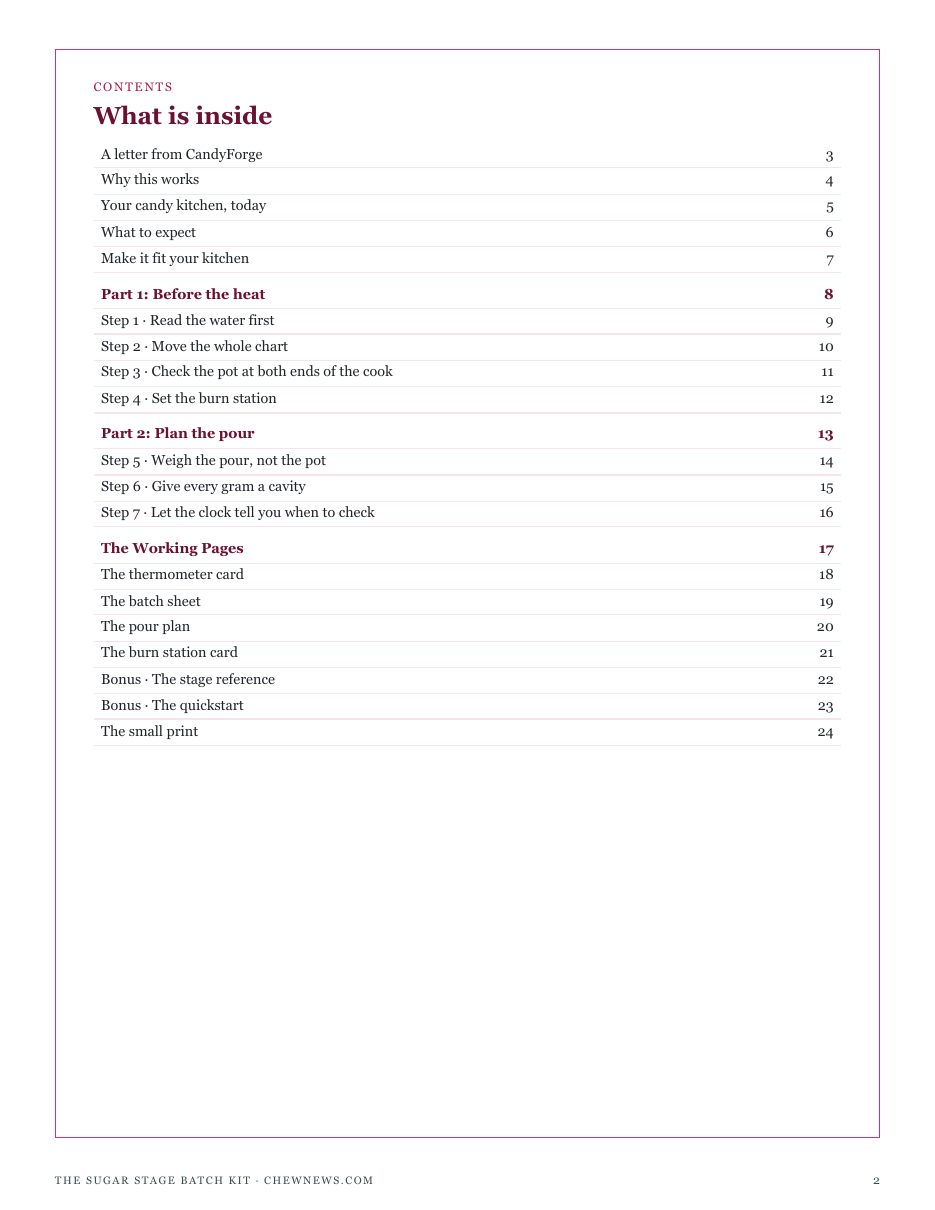
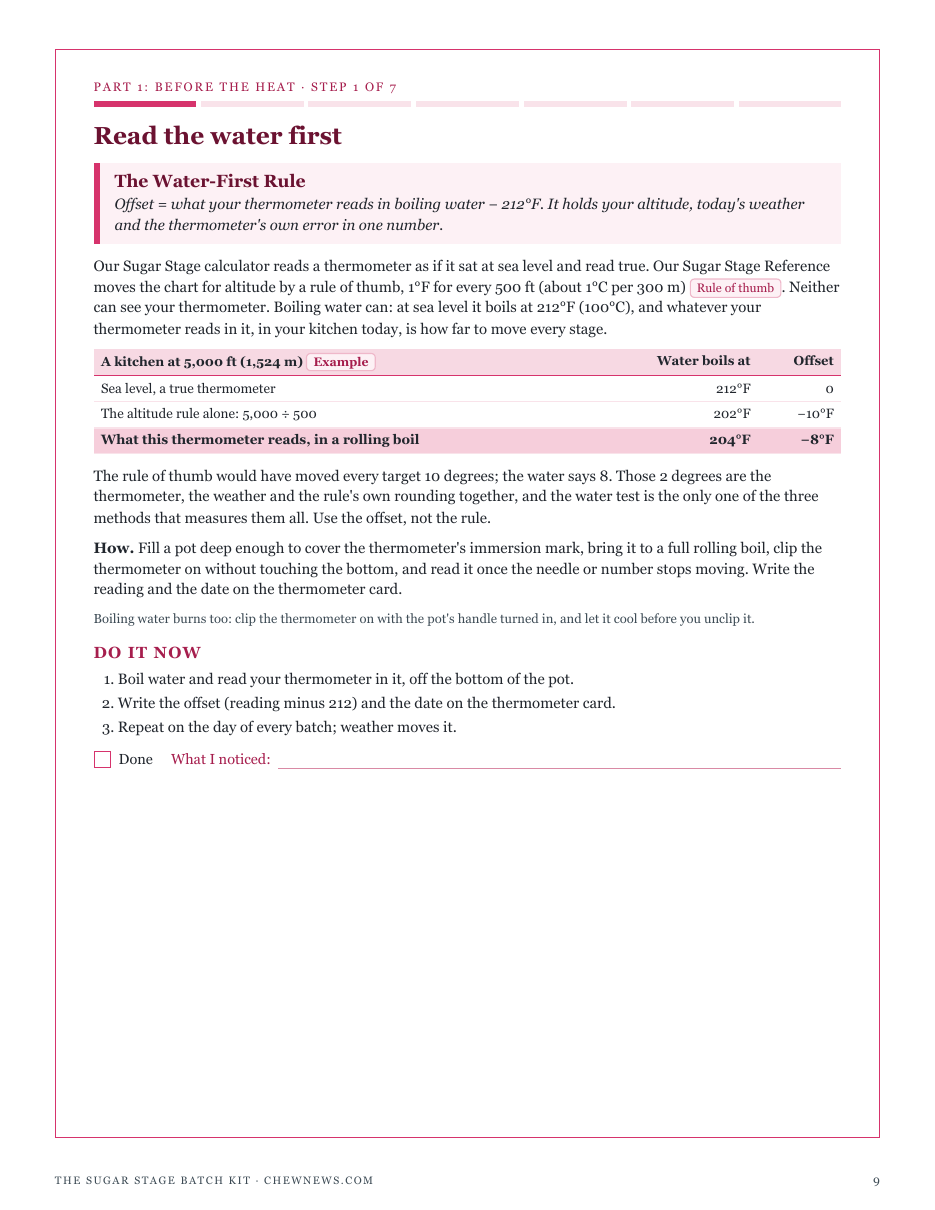
What is in it
- The Water-First Rule: one boiling-water reading that holds your altitude, the weather and the thermometer's own error
- The Moved-Chart Rule: every stage moved by your offset, and what the calculator misreads without it
- The Half-Full Rule: the pot checked for foam at the start and thermometer depth at the end
- The Burn Station Rule: children and pets out, long sleeves, cold water, and burn first aid, set before the heat
- The Pour-Weight Rule: what a batch really pours at each stage, from the sugar and the stage
- The Every-Gram Rule: a cavity for every gram of the pour, trays rounded up, and a lined sheet for the rest
- The Earliest-Check Rule: the cooling estimate as the first moment to check, never the moment to handle
- Four working pages: a thermometer card, a batch sheet, a pour plan and a burn station card for the stove
- A stage reference: every stage at offsets from 0 to minus 20, the chart in Celsius, and the pour per 100 g of sugar
- A personalised sheet worked from the figures you enter in the sugar stage, syrup ratio, batch scaling, mold quantity and cooling time calculators
- ✓ 24 printable pages
- ✓ 10 sections, worksheets and templates
- ✓ A second PDF worked out from the numbers you enter
- ✓ No account needed, just an email address
- ✓ Instant download; link valid 7 days
Price includes any taxes. Sold by GrabURL, who handle checkout and support. The charge appears on your statement as GrabURL.
The kit picks up where the free Sugar Stage Calculator leaves off. The calculator names the stage for a reading as if every thermometer sat at sea level and read true; the kit moves the whole chart by one boiling-water reading, checks the pot at both ends of the cook, weighs the pour from the Syrup Ratio Calculator's sugar and the stage, gives every gram a cavity with the Mold Quantity Calculator, and sets a burn station before the heat goes on. It gives no nutrition, storage or shelf-life advice and recommends no brand. The worked figures are examples.